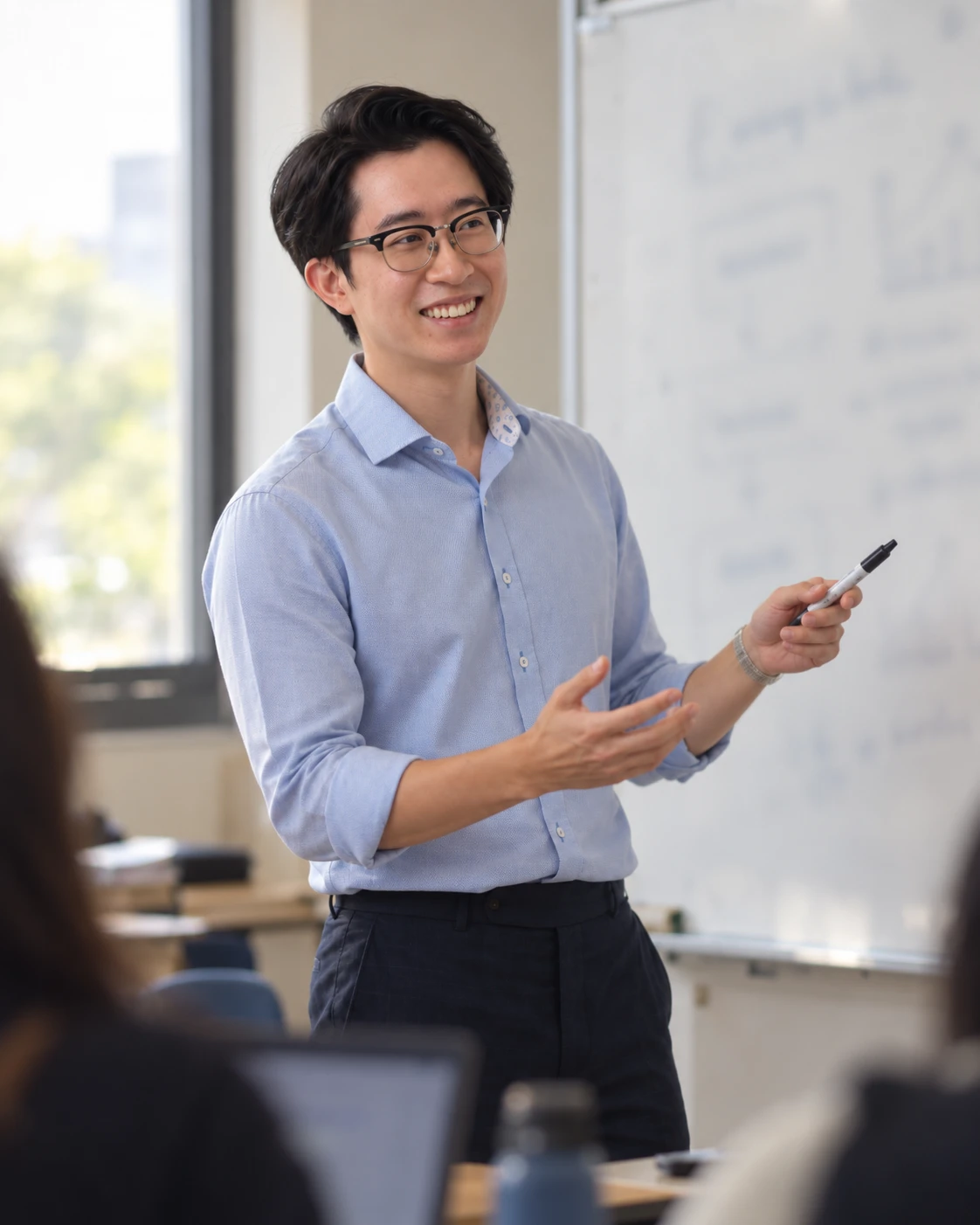
A MORNING OF SEC 1 ALGEBRA
Headstart
10am–1pm · 3 hours · one day
Time to work through the foundations of algebraic manipulation, step by step.
- Expansion and factorisation
- Substitution
- Algebraic fractions
- Linear equations
MATHS TUITION · SECONDARY & IP · BEAUTY WORLDMATHS · SEC & IP · BEAUTY WORLD
Marks are awarded for the steps, not the answer. Small-group tuition beside Beauty World MRT: classes of five, every line of working marked against the scheme, and a method your child can show on the day.
P6 TO SEC 1
WHAT’S CHANGING · 2026 TO 2028
Today’s Sec 3 students are the first to sit the Singapore-Cambridge Secondary Education Certificate, in 2027. SEAB keeps the standard and the grades. What changes is the name on the paper, the syllabus codes, and how much each maths grade counts towards junior college.
2026
This year’s Sec 4 students sit the GCE O-Level. Results come out in January.
2027
Maths and A Math at G3, the O-Level standard, carry new codes: K310 and K341.
2028
Four relevant subjects instead of five, so every maths grade carries more weight.
Our Sec 3 and Sec 4 classes follow the K310 and K341 syllabuses. Past O-Level papers are still good practice, because the standard is unchanged.
MOE’s syllabus puts problem solving at the centre of secondary maths. We teach students to plan a solution and show it, so an unfamiliar question is still one they can start.
With one fewer subject in the score, a lost method mark costs more. Working is marked line by line, so students keep the marks they already know how to earn.
THREE THINGS YOU WILL SEE
Homework comes back annotated against the mark scheme, so students learn where the marks live, and where they leak.
One table, five students. The tutor sees every line of working, in every lesson, for every student.
Timed sections from Term 2. Knowing a method and producing it in 90 seconds a mark are different skills.
OUR MISSION
To teach every student a method they can show on the day, in a room small enough that no line of working goes unread.
OUR VISION
Students who can mark their own working the way an examiner would, and so no longer need us.
Good tuition should make itself unnecessary. A student who can find the lost mark in their own paper keeps finding it, in every paper after ours.
01 · AT FIRST
The tutor marks every line. The student learns where the marks live.
02 · THEN
The student marks, the tutor checks. Most lost marks are the ones you award yourself.
03 · IN THE END
The student finds it alone. No red ink needed. That is the point.
HOW WE CHOOSE TUTORS
A tutor’s results are the answer. How they got there, and how they treat a student who is stuck, is the working. Mr Kheng, our Academic Director, sets the method every class is taught by, and every tutor who joins is weighed on all three before they teach one.
We look at where their students started and where they finished, and ask what changed. A tutor who cannot say why a student improved cannot make it happen again on purpose.
Every line of working read, homework marked against the scheme, one topic ahead of school. A tutor who teaches shortcuts to the answer is not right for this room, however good their results.
A student who is afraid of being wrong hides their working, and hidden working cannot be marked. So we hire tutors who stay calm, never hurry a student and are honest with parents. Like a B1, it is marked on its own: no result makes up for a tutor students are afraid to ask.
ACADEMIC DIRECTOR
As Academic Director he designs the method behind every Method & Mark programme: how a lesson runs, how far ahead of school it goes, and how homework is marked against the scheme, line by line. Every tutor teaches to it, whichever subject your child takes. He also teaches A Math, E Math and IP Maths himself.
THE CENTRE
By level and by current working grade, not by school. A class never exceeds five students, and we re-group at the end of each term if a student has moved ahead of or behind their group.
Your child joins a regular lesson at their level and works the same problems as everyone else. The tutor marks their working against the official scheme, and we go through it with you afterwards. There is no obligation to enrol.
The trial is a regular 2-hour lesson, and it is paid. Message us on WhatsApp for the current fee. There is no registration fee, and no obligation to enrol afterwards.
Our own, one topic ahead of most schools, so lessons at school become revision. We adjust for IP and O-Level or SEC tracks separately.
Yes. Students who are in Sec 3 in 2026 sit the Singapore-Cambridge Secondary Education Certificate (SEC) in 2027 instead of the O-Level. The standard and grading of G3 subjects stay the same as the O-Level, and our Sec 3 and Sec 4 classes follow the G3 syllabuses. From 2028, junior college admission uses an L1R4 score of 16 or less, with every counted subject taken at G3. What changes with the SEC.
Fees are charged four weeks at a time. Message us on WhatsApp for the current fee for your child’s programme. There is no registration fee or deposit. Missed lessons can be made up in another class of the same level within the term.
Sit in on a real lesson: same tutor, same class size, same marked working. You will see exactly how we teach before you decide anything.